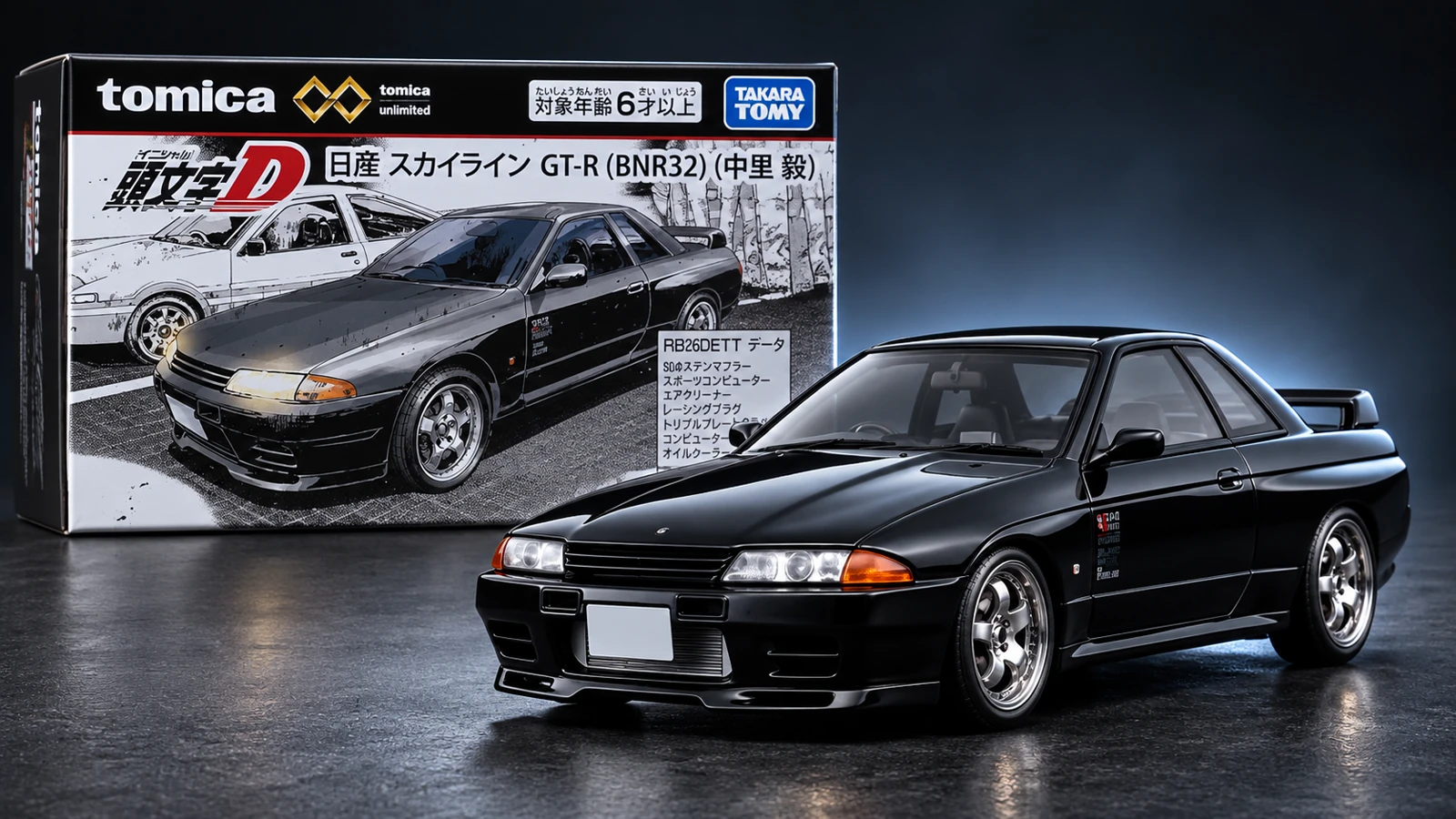
Primary keyword: Tomica Unlimited Nissan GT-R R32
Secondary keywords: Tomica Premium Unlimited Initial D R32, Takeshi Nakazato Skyline GT-R, Initial D Nissan R32 diecast, Tomica BNR32, NightKids R32 model
Part 1: The Black R32 That Challenged Takumi
The Tomica Unlimited Nissan GT-R R32 represents one of the most intimidating cars from the early chapters of Initial D. This is not a generic black Skyline or a simple colour variation of an existing casting. It recreates the Nissan Skyline GT-R BNR32 driven by Takeshi Nakazato, leader and ace of the Myogi NightKids.
Takara Tomy released the model in Japan on September 19, 2026, under the Tomica Premium Unlimited range. The official product information lists a 1:62 scale, working suspension and opening left and right doors. It also identifies the front bumper, lip spoiler, wheels, exhaust and seats as areas designed to reproduce Nakazato’s customised car as closely as possible.
Those details matter because Nakazato’s R32 has a very specific presence. The black body, wide stance and squared shape create a complete contrast with Takumi Fujiwara’s lighter, smaller Toyota AE86. Where the AE86 represents balance, momentum and driver adaptability, the R32 represents power, grip and mechanical confidence. Putting the two Tomica cars beside one another immediately recreates one of the central conflicts that made the early story memorable.
For collectors in the UAE and wider GCC, the model crosses several audiences. It appeals to Tomica fans, Skyline collectors, Nissan enthusiasts, Initial D followers and people building displays around 1990s Japanese performance cars. The R32 is already one of the most recognised Japanese cars ever made. The NightKids connection gives this miniature an additional identity that a standard road-car casting cannot offer.
What is this Tomica Premium Unlimited release?
Its complete official name is Tomica Premium Unlimited Initial D Nissan Skyline GT-R (BNR32) (Takeshi Nakazato). The official Japanese retail price was ¥1,430 including tax at launch. Retail and resale prices can change, especially when initial stock sells out, so the manufacturer price should be treated as a reference rather than a guaranteed current buying price.
The Premium Unlimited line allows Takara Tomy to reproduce vehicles as they appear in entertainment properties. That distinction is important. A standard Tomica Premium R32 represents the real production car. The Premium Unlimited version represents a named character’s machine, including visual changes associated with Nakazato.
The model uses 1:62 scale. That is close to the general size of many 1:64 diecast cars, although strict scale collectors will notice that it is not exactly the same. Tomica often balances printed scale with a consistent physical format, working features and packaging. When displayed alongside other Tomica Premium Unlimited Initial D vehicles, the R32 should still look visually coherent.
The body is black, matching Nakazato’s car and the NightKids image. Black is effective at this scale because it emphasises the R32’s solid, planted silhouette, but it can hide body lines in poor lighting. The casting therefore depends on clean reflections, accurate panel lines and contrasting details around the lights, grille, wheels and windows.
Opening doors give the model more display flexibility. Collectors can view the seats and dashboard, photograph the car with one door open or arrange it in a garage scene. Suspension adds a traditional Tomica play feature and helps all four tyres sit naturally on a slightly uneven display base.
Takeshi Nakazato and the Myogi NightKids
Takeshi Nakazato leads the Myogi NightKids, a street-racing team associated with Mount Myogi. He is serious, proud and convinced that grip driving with the right machine is the fastest approach. His black R32 suits that personality. It looks heavy, disciplined and purposeful rather than playful.
Nakazato’s driving philosophy was shaped by an earlier defeat while driving a Nissan Silvia S13. After losing to an R32, he chose the Skyline GT-R because he believed its power and all-wheel-drive traction offered the strongest route to victory. His confidence in the car becomes central to his challenge against Takumi.
The rivalry is more interesting than a simple comparison of horsepower. On paper, the R32 appears to have every advantage over the older AE86: turbocharged power, all-wheel drive, a wider footprint and a more sophisticated performance system. The mountain road changes the calculation. Weight, braking, corner entry and the driver’s ability to manage the road become just as important as acceleration.
Nakazato remains memorable partly because he is not treated as a joke. He is a credible early opponent with a serious machine. His losses do not erase the threat created when the black GT-R first appears. The R32 establishes that Takumi will face cars with far more power and technology than his AE86.
Shingo Shoji’s red Civic EG6 represents another side of the NightKids. Shingo relies on provocation and dangerous rules, while Nakazato presents himself as the team’s disciplined leader. Displaying the black R32 beside the red EG6 therefore does more than match team colours. It shows two different personalities within the same group.
Why the R32 versus AE86 battle matters
The battle brings two opposite ideas together. Nakazato believes the GT-R’s grip and power will control the race. Takumi relies on familiarity with the road, lightness and smooth use of momentum. The result helped establish one of Initial D’s recurring themes: a faster specification does not automatically produce a faster mountain run.
The R32’s weight becomes part of the story. Strong acceleration and traction can help it launch out of corners, but a heavier car demands more from its tyres and brakes. The narrow downhill environment does not give Nakazato unlimited space to use the GT-R’s performance.
For collectors, that conflict gives the two-car display meaning. The black R32 should not merely sit in a row behind the AE86. Place them facing the same direction with the R32 slightly behind, or angle them toward one another before an imagined race. Even someone unfamiliar with the full scene can understand the contrast between the compact panda-coloured hatchback and the dark, wide Nissan coupe.

The real Nissan Skyline GT-R BNR32
Nissan revived the Skyline GT-R name with the BNR32 generation in 1989. The car was engineered around motorsport requirements and became closely associated with Japanese Group A touring-car competition. Its success helped turn the R32 into an international symbol of Japanese performance engineering.
The production GT-R used Nissan’s RB26DETT, a 2.6-litre twin-turbocharged inline-six engine. Official Japanese output followed the period’s 280 PS convention, although the engine became famous for supporting substantially more power when modified. The car also used the ATTESA E-TS all-wheel-drive system and Super-HICAS rear-wheel steering.
These systems gave the R32 a distinct personality. Under normal conditions, the drivetrain could retain a rear-biased feel, while sending torque forward when needed. That mixture of traction and agility made the GT-R highly effective on circuits and fast roads. It also explains why Nakazato sees the car as a decisive advantage.
The BNR32 is larger and more technical than Takumi’s AE86, but it retains a clean shape. Its straight beltline, compact greenhouse, four round rear lamps and restrained aero make it easy to recognise. The design does not need a huge wing or exaggerated body kit to look serious.
The black Initial D car adds carefully chosen modifications rather than transforming the basic identity. That is why the Tomica model’s front bumper, lip spoiler, wheels, exhaust and seats deserve attention. Those parts separate Nakazato’s machine from a standard showroom-style BNR32.
Why this model has strong collector appeal
The strongest reason is the combination of an important real car and a specific fictional identity. Many companies have produced R32 miniatures, but not every model represents Takeshi Nakazato’s car with official Initial D licensing.
It also fills an obvious role in an Initial D collection. Takumi’s AE86 is the foundation, while Nakazato’s R32 is one of the first machines that makes the hero car look genuinely outmatched. The black Skyline adds visual weight to a display dominated by white, yellow and red cars.
The official moving features increase its appeal beyond sealed-box collecting. Opening doors reveal the interior, and suspension makes the model enjoyable to handle carefully. The original Japanese price also positioned it as an accessible character model rather than a fragile high-end replica.
At Retros.ae, a release like this should be grouped with other Initial D, Tomica and Nissan models. A buyer searching for Nakazato’s R32 may also want Takumi’s AE86, Shingo’s Civic EG6 or another Skyline generation. Related links help collectors build a themed display instead of purchasing a single disconnected car.
No mass-produced diecast should be treated as a guaranteed investment. Values depend on supply, condition, reissues and collector interest. Buy this R32 because it belongs in your collection first. Any future increase in value should be secondary.
Part 2: Casting Details, Features and Quality Checks
Proportions and first impression
The R32 is a difficult car to miniaturise because its shape is simple. On an exotic car, dramatic wings and deep vents can distract from small errors. The Skyline depends on the relationship between its bonnet, roof, windows, wheel arches and boot. If one proportion is wrong, the whole casting feels wrong.
From the front three-quarter angle, check the width and height of the grille, the rectangular headlights and the position of the front bumper openings. The bonnet should look long enough to suggest the straight-six engine beneath it, while the cabin should sit slightly rearward.
From the side, inspect the roofline and rear quarter. The R32 is a two-door coupe, so the door must be long and the rear side window compact. The model should not resemble a four-door Skyline sedan. Door seams need to remain visible without becoming oversized because of the opening mechanism.
The rear view is essential. Four round taillights are one of the GT-R’s defining features. Their alignment, size and printed separation strongly affect how convincing the model looks. A clean rear bumper and visible exhaust complete the appearance.
Black paint can make details difficult to see. Under direct light, it can also reveal dust, fine scratches and uneven surfaces more clearly than lighter colours. Inspect the model under soft, angled lighting rather than a harsh phone flash.

Front bumper and lip spoiler
Takara Tomy specifically identifies the front bumper and lip spoiler as Nakazato customisation points. These parts give the miniature a lower, more aggressive face. At 1:62 scale, even a small change in lip depth can change the stance.
Check that the lower lip sits evenly and does not bend upward on one side. Inspect the paint around the bumper openings and the boundary between black bodywork and darker grille areas. The headlight printing should align with the moulded lenses or shapes.
The front number-plate area should also sit straight. A crooked plate or uneven bumper is more visible on a black model because highlights form clear lines across the surface. When photographing the car, position a long soft light above it so the reflection follows the bonnet and roof without hiding the grille.
Wheels, tyres and stance
Wheels are among the easiest ways to distinguish a character-specific model from a generic casting. Nakazato’s R32 needs a purposeful, tuned appearance. The official description lists the wheels among the reproduced custom details.
Look at both sides of the car. Each wheel should sit at a similar depth within the arch, and the axles should appear straight. Roll the model gently across a clean, flat surface. It should move freely without a wheel lifting, dragging or wobbling heavily.
The suspension allows slight vertical movement. Press gently over each axle and release. The body should return without remaining tilted. Do not push hard on the roof or spoiler because the mechanism requires only light pressure.
The stance should look low but not broken. The tyres need enough clearance to roll, so a Tomica model may sit slightly higher than a static resin display piece. That compromise supports durability and playability.
Opening doors and interior
Both front doors open. This feature gives collectors a clearer view of the seats, dashboard and right-hand-drive layout. The official product description specifically names the seats as another Nakazato custom point.
Use a fingernail or soft plastic pick to open a tight door. Avoid metal tools because they can chip the black paint or scratch the window. Move each door slowly and stop if the hinge resists sharply.
For interior photography, place the key light above and slightly ahead of the model. Black seats inside a black car can disappear without reflected light. A small white card opposite the lamp can brighten the cabin while keeping reflections soft.
Door gaps are unavoidable on a moving diecast model. Judge them based on consistency rather than expecting the nearly invisible seams of a sealed resin replica. When closed, the doors should sit reasonably level with the front fenders and rear quarters.

Exhaust and rear details
The muffler is another officially identified custom feature. Photograph it from a low rear three-quarter angle so readers can see its size and position. The exhaust should appear attached cleanly rather than hanging at an unnatural angle.
The four rear lamps should be one of the strongest visual details. Check for clean circular printing with no large gaps or smears. Inspect the GT-R badge, boot lines and rear window printing if present.
The rear spoiler contributes to the R32 profile without dominating it. View the model directly from behind to confirm that the spoiler sits level. Thin diecast or plastic components can occasionally shift during packaging or shipping.
Packaging and condition
The box identifies the model as an official Initial D character car. For sealed collectors, package condition can be nearly as important as the miniature. Check corners, print quality, crushing, tears and heavy retailer labels.
Takara Tomy lists the package at 120 mm wide, 78 mm high and 39 mm deep. That compact size is easy to store, but the box can be crushed if shipped in a soft envelope. Ask the seller to use a rigid outer carton with padding.
Decide whether you are buying for sealed display or to open and photograph. A sealed example preserves original presentation. An opened example allows you to use the doors and suspension and inspect the custom interior. Neither approach is wrong.
Some collectors purchase two copies, but that is only sensible if the price and storage requirements fit your budget. Do not buy multiples merely because social media suggests the release will become rare.
How it compares with more expensive R32 models
Premium 1:64 brands may offer finer printed badges, separate mirrors, detailed brakes, photo-etched parts or stricter scale accuracy. Resin models may reproduce very small body modifications but often lack rolling wheels and opening parts.
The Tomica Premium Unlimited R32 takes a different position. It combines official character licensing, recognisable styling, opening doors, suspension and an accessible original price. It is designed to be displayed but remains sturdy enough for careful handling.
Choose based on your collecting goal. If you want extreme macro detail, a higher-priced display model may suit you better. If you want to build a broad Initial D lineup without spending heavily on every car, the Tomica offers a strong balance.
Scale should also be considered. This release is 1:62, not strict 1:64. The difference will matter to collectors building a precisely scaled diorama. In a Tomica-focused display, it is unlikely to be distracting.
What to check before buying online
Confirm the complete product name and JAN code. The official item is the Nissan Skyline GT-R BNR32 driven by Takeshi Nakazato, with product number 4904810994329. This helps distinguish it from regular Tomica Premium R32 releases, older Dream Tomica versions and unofficial customs.
Check whether the listing shows actual stock, a preorder or a resale item. Ask for real photographs if package condition matters. Confirm whether the model is sealed and whether returns are accepted for serious defects or shipping damage.
Compare the price with the original Japanese retail price, then allow for international shipping, import costs and local seller expenses. UAE pricing will naturally be higher than the original ¥1,430 Japanese price. A large difference should still have a clear explanation.
Use a seller with visible contact details and specific product descriptions. Retros.ae can help UAE collectors check Japanese diecast releases locally and browse related Skyline, Tomica and Initial D models. If the R32 is unavailable, contact the shop about restocking rather than immediately paying an inflated marketplace price.
Part 3: Displaying, Photographing and Buying the R32
Is the Tomica Initial D R32 worth buying?
For an Initial D collector, yes. Nakazato’s R32 is not a background vehicle. It represents a major early rival, the leader of the Myogi NightKids and the first clear demonstration that Takumi can defeat a much more powerful machine.
For a Skyline collector, the answer is also strong if character cars fit your collection. The BNR32 is one of Nissan’s defining performance models, and the black NightKids specification gives it a different identity from factory-colour or racing-livery versions.
For a strict 1:64 collector, the 1:62 scale requires consideration. It will be slightly different from models built to exact 1:64 dimensions. The moving features and Tomica construction may also produce larger panel gaps than sealed premium replicas.
The best reason to buy it is the combination of real engineering history and fictional narrative. It works as a miniature R32, but it becomes more meaningful when paired with the characters and battles surrounding it.
Best display pairings
The essential partner is Takumi’s AE86. Together, the cars represent grip, power and technology against lightness, balance and local knowledge. Use a black or dark-grey road base, but add enough side lighting to separate the R32 from the background.
The second pairing is Shingo’s red Civic EG6. Both cars belong to the Myogi NightKids, but the colour contrast keeps the shelf visually interesting. Place the black R32 slightly higher or behind the Civic to reflect Nakazato’s role as team leader.
Keisuke Takahashi’s yellow Mazda RX-7 FD3S adds another strong colour and another major rival. A four-car arrangement with the AE86, R32, EG6 and FD3S tells a coherent early-series story without requiring a large shelf.
Clear acrylic risers work well because the black R32 can disappear behind other cars on a flat shelf. Raise it by 30–50 mm and angle it toward the centre. Keep the box behind or beside the model if you want viewers to understand the official licence immediately.

Photographing a black diecast model
Black models need deliberate lighting. A front-facing flash produces harsh white spots while leaving the sides too dark. Use a large diffused light above and slightly to one side. A bright window with thin curtains can work if direct sunlight is avoided.
Place a white card outside the frame on the darker side of the car. It will create a soft line across the doors and rear quarter, revealing the shape without changing the black colour. A narrow light reflection along the roof and bonnet helps define the R32’s straight surfaces.
Use a neutral background rather than pure black. Charcoal grey, concrete texture or dark blue gives the body enough separation. If you use a mountain-road diorama, add a small warm lamp or guardrail reflector behind the vehicle.
Keep the camera near headlight height for the front three-quarter shot. A high angle makes the model look smaller and hides the front bumper. Use the phone’s main camera without digital zoom, tap the front wheel or headlight to focus and reduce exposure slightly if reflections become too bright.
The essential angles are front three-quarter, side profile, rear three-quarter and direct rear. Add a close-up of the open doors and seats. Remove dust before shooting because tiny fibres become highly visible on glossy black paint.
Protecting the black finish
Handle the model by the lower sides rather than pressing on the roof, windows or spoiler. Clean, dry hands reduce fingerprints. A soft air blower and clean detailing brush are safer than household sprays.
Do not rub dry dust aggressively across the black paint. Fine marks are more visible on dark glossy surfaces. Blow loose particles away first, then use a very soft microfibre cloth only when necessary.
Keep the model and box away from direct sunlight and extreme heat. UAE car interiors can become hot enough to damage packaging and plastic components. Store the model indoors in a stable environment.
An acrylic display case reduces dust and accidental contact. If you display a door open, make sure it remains stable without pressure on the hinge. Close both doors before moving or storing the model.
Building a NightKids collection
A focused NightKids display can begin with only two models: Nakazato’s black R32 and Shingo’s red EG6. The pairing has strong visual contrast and a clear story. Add a small Myogi-inspired mountain base, guardrail and team-colour lighting without copying an anime frame.
Position Nakazato’s car in the centre or on a higher riser. Place the Civic slightly forward and at an angle. If Takumi’s AE86 is added, position it opposite the two NightKids cars to create a simple confrontation scene.
Keep packaging together if you intend to preserve a matched collection. Record the purchase date, seller, price and condition. A basic spreadsheet or phone note is enough. Photograph each model and box when they arrive.
Browse Retros.ae using several terms: “Initial D,” “R32,” “Skyline GT-R,” “Nakazato” and “Tomica Premium Unlimited.” Product titles can vary, and one search phrase may not reveal every related item.
Frequently asked questions
What scale is the Tomica Premium Unlimited Initial D R32?
Takara Tomy lists the model at 1:62 scale.
Which character drives the black R32?
The black Nissan Skyline GT-R BNR32 belongs to Takeshi Nakazato, leader and ace of the Myogi NightKids.
Does the Tomica R32 have opening doors?
Yes. Both front doors open, and the model also includes suspension.
What custom details does the model reproduce?
Takara Tomy identifies the front bumper, lip spoiler, wheels, muffler and seats among the reproduced Nakazato-specific custom points.
Is it a regular Skyline R32 or an official Initial D model?
It is an officially licensed Initial D release under the Tomica Premium Unlimited range. The package and model represent Nakazato’s car rather than a generic production R32.
When was it released?
Takara Tomy lists the Japanese release date as September 19, 2026.
What was the original Japanese price?
The official Takara Tomy Mall price was ¥1,430 including tax at launch. Current retail and resale prices may differ.
Is it exactly 1:64 scale?
No. The printed scale is 1:62. It remains close in size to many 1:64 models but may appear slightly larger in a strict mixed-scale display.
Should I keep it sealed?
Keep it sealed if package condition is central to your collection. Open it if you want to use the doors and suspension, inspect the interior or photograph it in a diorama.
Where can UAE collectors look for it?
Check Retros.ae for current availability and related Japanese diecast models. Stock and price can change, so use the live product listing or contact the shop directly.
Final verdict
The Tomica Unlimited Nissan GT-R R32 works because it captures several identities in one compact model. It is a BNR32 Skyline, a black NightKids machine, Takeshi Nakazato’s chosen weapon and a physical reminder of one of Takumi’s defining early races.
Takara Tomy has included the features most likely to matter at this price and size: character-specific exterior parts, opening doors, visible interior changes and suspension. It will not replace a highly detailed resin R32 for collectors who demand microscopic accuracy, but it offers a convincing and accessible way to add Nakazato’s car to an Initial D lineup.
The model is strongest beside the AE86. The contrast between the two cars explains the battle before a viewer reads a single line: large against small, black against white, grip against momentum and technology against experience.
For Nissan fans, it celebrates the R32’s lasting place in Japanese performance history. For Initial D fans, it completes the Myogi NightKids story. For Tomica collectors, it adds a recognisable licensed machine with moving features and strong shelf presence.
Browse Retros.ae for Tomica, Initial D and Nissan Skyline diecast models available to collectors in the UAE. Check current listings for live stock and pricing.
links
- Retros.ae
- Explore more Tomica diecast models.
- Browse our Initial D models.
- Discover more Nissan Skyline diecast models.
- Compare it with Takumi’s AE86 and Shingo’s Civic EG6.
image captions
- Takeshi Nakazato’s black Nissan Skyline GT-R BNR32 recreated by Tomica Premium Unlimited.
- The R32 and Takumi’s AE86 represent power and grip against lightness and momentum.
- Four views reveal the R32’s bumper, lip spoiler, wheels, taillights and exhaust.
- Opening doors provide a closer view of Nakazato’s customised interior.
- The black R32 anchors a focused Myogi NightKids or early Initial D display.
- Check Retros.ae for current UAE availability of Tomica and Japanese diecast models.
Leave a Reply