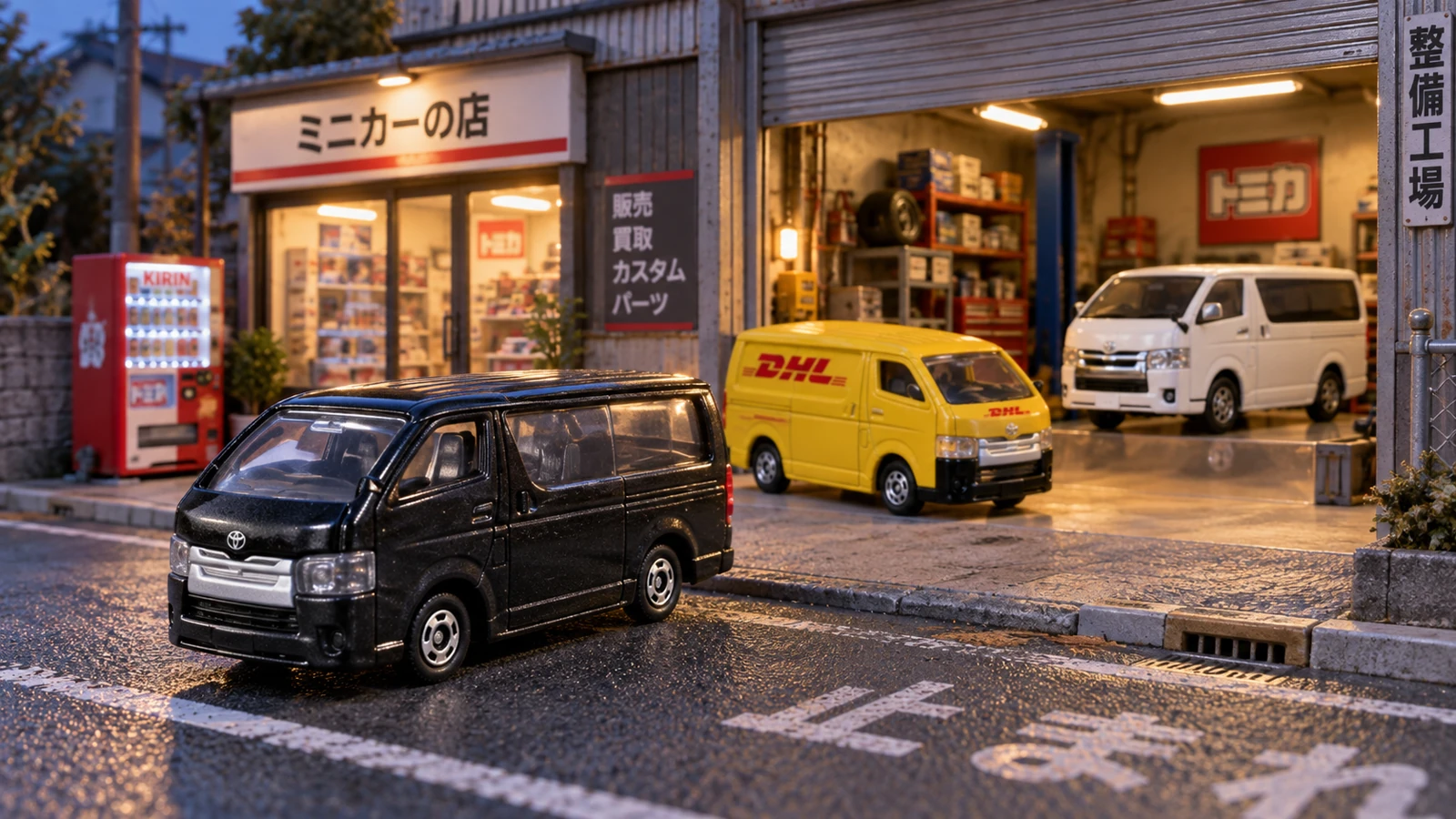
Primary keyword: Tomica Hiace diorama
Secondary keywords: Toyota Hiace diecast, Tomica van, miniature garage display, diecast shop diorama, Japanese street diorama, 1:64 scenery ideas

Part 1: Why a Tomica Hiace Makes a Diorama Feel Real
A row of sports cars can look impressive, but it does not always look like a real place. Real streets contain delivery vans, work vehicles, parked family cars and commercial traffic. A garage is not occupied only by tuned coupes. A shop does not receive stock without a delivery vehicle. This is why a Tomica Toyota Hiace can improve a miniature scene more than another expensive supercar.
The Hiace gives the display a purpose. Place one outside a miniature workshop and viewers immediately understand that parts, tools or tyres may have arrived. Park a DHL Hiace beside a shop and the scene begins to suggest movement: a driver has stopped, a parcel is being delivered and the business is operating. Put a clean white Hiace inside a detailed garage and it can represent a customer vehicle, a workshop project or a van being prepared for commercial use.
That difference matters in diecast photography. A display becomes convincing when every object appears to belong there. The Hiace is useful because it is familiar, practical and visually different from low sports cars. Its tall body introduces another height into the composition. Its broad sides catch light differently. Its box-like shape makes the scale of doors, signs, shelves and figures easier to judge.
Toyota presents the real Hiace as a commercial vehicle built around cabin and cargo capacity. That practical identity is exactly what makes the miniature version valuable as scenery. It looks at home beside a loading bay, convenience store, parts shop, workshop entrance or urban parking space. It does not need racing graphics or an aggressive stance to explain its role. Its ordinary shape does the work. (Toyota Hiace overview)
The difference between a collection and a miniature world
A collection displays objects. A miniature world shows relationships between objects.
If six cars are arranged in a straight line on a shelf, the viewer sees six models. If a black Hiace is parked beside a workshop, a mechanic figure stands near an open bay and two sports cars wait outside, the viewer sees a business. The same cars now participate in a scene.
The Hiace is especially effective as a supporting model. It does not have to dominate the frame. Its job is to connect the building, road and hero car. A tuned Skyline can remain the main subject while the van explains what kind of place surrounds it. Perhaps the Skyline is visiting a tuning shop. Perhaps the Hiace belongs to the garage and carries tools. Perhaps it has delivered wheels for the next modification.
This storytelling effect is useful for product photography too. When you photograph a diecast car for a blog or online shop, a Hiace can make the image feel less like a catalogue photo and more like a moment from a real Japanese street. The important point is restraint. The van should support the featured model, not block it.
Why the Hiace shape works so well in small scale
The Toyota Hiace has a tall, simple profile. In miniature form, that gives you several advantages.
First, it creates vertical variety. Most 1:64 sports cars sit low, so a display made only from performance cars can look visually flat. The van creates a second height level without needing another building.
Second, its large side panels are readable from a distance. A black van creates a strong dark mass, a white premium model reflects light cleanly, and a yellow DHL version adds a bright commercial accent. You can identify each role even in a wide cabinet photograph.
Third, the van helps reveal scale. Put it near a shop doorway and the viewer can compare the vehicle with the building. Place a small parcel trolley beside the DHL van and the working scene becomes easier to understand. Position it behind a low coupe and the difference in body height produces depth.
Finally, a Hiace looks believable when parked. Some race cars appear unnatural when left on an ordinary street with no racing context. A van naturally belongs in a static position. It can wait beside a kerb, reverse toward a loading area or remain outside a closed garage after business hours.
Three Hiace versions, three different stories
The three models shown here are not interchangeable. Each creates a different mood.
The black Tomica Hiace works well in urban scenes. Its dark finish suits night photography, underground parking, tuning shops and discreet service-vehicle displays. It can also sit in the background without taking attention away from a brighter hero car.
The yellow DHL Hiace introduces instant activity. Even before you add figures or parcels, the delivery livery tells viewers what the van is doing. It is ideal for a miniature hobby shop, parts store, warehouse, convenience store or online business scene.
The white Tomica Premium Hiace suits cleaner displays. Its light colour and more detailed presentation work well in a modern garage, dealership, showroom or premium collector shelf. If the model includes opening features, photograph them carefully because they help show interaction between the van and its surroundings.
You do not need all three in one scene. In fact, using one carefully chosen Hiace usually looks more natural. Choose the version that explains the location.
eryday van can make a miniature garage or shop scene feel active and believable.

Part 2: How to Use a Tomica Hiace in Shops, Garages and Street Scenes
The best dioramas do not need many accessories. They need clear logic. Before placing the Hiace, decide who owns it, why it is there and what happened immediately before the photograph.
This simple approach prevents random placement. A DHL van should normally stop where a courier could reach the entrance. A workshop van should sit near tools, tyres or a service bay. A passenger Hiace should use a normal parking space rather than blocking a loading dock. When the vehicle follows the logic of the location, the entire scene feels more realistic.
Idea 1: A delivery outside a miniature diecast shop
The DHL Hiace is the strongest choice for a retail scene. Park it close to the shop but leave enough room to see the entrance. Angle the front wheels slightly toward the road, as if the driver has just pulled in for a short stop.
Add two or three small parcels near the side or rear of the van. Do not cover the model with boxes. One hand trolley, a delivery figure and a parcel beside the door are enough to tell the story.
Inside the shop window, place miniature car boxes, shelves or posters. Keep the featured sports car near the front of the frame, while the DHL van sits slightly farther back. This arrangement lets the commercial van create context without replacing the main subject.
For lighting, use a warm shop interior and cooler light on the pavement. The temperature contrast separates the building from the vehicle and suggests evening trading. If the yellow van becomes too bright, reduce direct light rather than darkening the entire scene.

Idea 2: A black Hiace outside a tuning garage
The black Hiace suits a darker workshop scene. Position it beside the building rather than directly in front of the main bay. This makes it look like the garage’s support vehicle while keeping the entrance clear for the featured car.
A black van can disappear against a dark wall, so use a soft rim light along the roof and rear edge. A small white sign or illuminated vending machine behind it can also separate the silhouette. Avoid placing the van against a pure black background with no reflected light.
To strengthen the workshop story, add a wheel stack, oil drums, a tool cabinet or a small compressor. Choose two accessories, not ten. Too many miniature items can make the scene look like a toy box instead of a functioning garage.
The Hiace should show signs of use through its placement, not artificial damage. Slightly imperfect parking, a toolbox beside the side door or a mechanic walking toward it is more convincing than excessive weathering.
Idea 3: A premium Hiace in a clean workshop
The white Tomica Premium Hiace belongs in a brighter environment. Use it in a dealership service bay, detailing studio or modern custom workshop. White walls, grey flooring and overhead strip lights create a clean setting that contrasts with the older street-style garage used for the black model.
If the van has opening doors, use one image to show the feature, but keep the main scene natural. Both doors opened to their maximum angle can look like a product demonstration. One open side door, a small equipment case and a worker figure usually tell a more believable story.
The white body also works as a light reflector within the scene. It can brighten the side of a nearby dark sports car. Watch the exposure, however, because the white paint may lose its panel lines if the lighting is too strong.

Idea 4: A normal Japanese street
You do not always need a garage. A Hiace can make a simple road diorama more believable.
Park the black van beside a narrow pavement, utility pole or small apartment. Place a kei car ahead of it and a sports car passing on the road. The scene now feels like a neighbourhood rather than a car meet.
For a daytime image, use soft window light and neutral shadows. For night, add one overhead streetlamp and reflected light from a shop sign. Keep the road surface matte. A glossy road is useful for rain scenes but can look like plastic under normal conditions.
Use road markings carefully. If the van is meant to be in Japan, left-side traffic, Japanese-style signs and appropriate parking orientation help. You do not need to reproduce a specific real street. An original setting inspired by common details is safer and gives you more control.
Idea 5: A small warehouse or loading bay
The DHL Hiace can anchor a warehouse diorama. Reverse it toward a low platform and leave a small gap behind the vehicle. Add a pallet, hand truck and overhead loading light.
The critical detail is scale. Loading doors designed for a large truck can make a compact van appear unnaturally small. Match the doorway, platform and accessories to the model. Test the layout before gluing anything in place.
You can also use forced perspective. Put smaller boxes and less detailed scenery toward the back while keeping the Hiace and main props near the camera. This creates the impression of a deeper warehouse without requiring a large display case.

Positioning rules that improve realism
Keep all wheels on the surface. A single floating tyre or uneven acrylic riser immediately breaks the illusion. Check each wheel from the camera angle, not only from above.
Leave working space around doors. If a van is beside a wall, make sure a driver could reasonably exit. If parcels are being unloaded, leave a route from the van to the shop.
Avoid perfect symmetry. Real vehicles rarely park in an exact exhibition pattern outside a working garage. Small differences in angle and distance make the scene feel less staged.
Use figures to indicate action, not to fill empty areas. One mechanic looking into a bay is more useful than five people standing without purpose.
Keep the hero clear. If the article is about a Skyline, the Skyline should still receive the sharpest focus and strongest light. The Hiace provides context. If the article is about the Hiace itself, reverse that hierarchy and let the sports cars become background detail.
Matching scale when Tomica models vary
Tomica vehicles are designed as compact diecast toys, and different castings may not share one perfectly uniform scale. That does not prevent a convincing diorama, but you should compare models before final placement.
Place the Hiace beside the car you plan to photograph. Check roof height, wheel size and door proportions. If one model looks slightly larger, position it closer to the camera only if that supports the perspective. Otherwise, move the larger casting farther back.
Buildings are more forgiving than figures. A doorway can represent different dimensions, but an oversized person standing beside the van makes the mismatch obvious. When uncertain, photograph without figures or keep them deeper in the scene.

Part 3: Building and Photographing a Better Hiace Display
A convincing Tomica Hiace diorama depends more on composition and light than expensive materials. You can build a useful garage corner from printed walls, textured card, a small shelf and a few carefully chosen accessories. The goal is not to reproduce every object found in a real workshop. The goal is to include the objects that explain the scene.
Start with a simple base
For a garage, use a neutral concrete floor in grey or slightly warm beige. Fine sandpaper, printed texture or painted foam board can work. Avoid texture that is too coarse for the model’s scale. Large grains may look like stones beside the small wheels.
For a shop, divide the base into pavement and road. A subtle kerb helps separate pedestrians from vehicles and gives the Hiace a believable stopping point. Add a drain cover or one patched area to break up the surface, but keep enough clean space for the models.
For a collector cabinet, clear acrylic risers can create height without building a full diorama. Put the Hiace on the lower level and smaller or brighter cars behind it. The tall van may already provide enough visual height, so test the arrangement before adding a riser beneath it.
Build the scene around a reason
Ask one question: why is the Hiace here?
If it is delivering parcels, show a shop entrance and a small package. If it belongs to the garage, show tools or parts nearby. If it is a customer van, point its nose toward the service bay. If it is parked on a street, include a kerb and normal traffic context.
This reason should guide every accessory. A delivery scene needs boxes more than spare engines. A detailing studio needs bottles, cloths or lighting rather than racing barriers. A neighbourhood street needs signs and pavement rather than a full tool wall.
Use colour to control attention
The yellow DHL Hiace naturally attracts attention. If it is the background vehicle, reduce its brightness with softer light or place it deeper in the frame. Do not hide it completely, because its livery is the reason for using it.
The black Hiace needs edge separation. A cool rim light, pale wall or illuminated sign will define its roof and windows. Keep direct reflections long and soft so the dark body retains its shape.
The white premium Hiace can dominate a dark scene even when placed far away. Use it against a medium-grey wall rather than pure black, and protect highlight detail on the bonnet, roof and side panels.
Try to repeat each vehicle colour once elsewhere in the scene. A small yellow sign can connect with the DHL van. A black tool cabinet can support the black Hiace. A white garage sign can balance the premium model. The repeated colour should be subtle.
Camera height matters
Photograph the model near window height for a realistic street or garage view. A camera placed far above the scene makes the vehicles look like toys on a table. A lower angle makes the building, van and road relate more naturally.
Use a front three-quarter angle when you want to show the Hiace shape. Use a side view when the DHL graphics or shop relationship matters. Use a rear three-quarter view for loading scenes. A top-down view is useful as a secondary inspection image but rarely works as the main emotional photograph.
Keep the camera level unless the scene intentionally represents a slope. Small tilts become obvious when the garage door, utility poles and van body should be vertical.
Lighting a small van
Start with one large, soft light above and slightly in front of the model. Add a white card on the darker side to lift the shadows. This basic setup is often enough.
For the black Hiace, add a narrow rim light behind the vehicle. For the white model, reduce the strongest light or move it farther away. For the DHL van, watch red and yellow saturation so the livery remains readable.
If you use practical miniature lights, treat them as part of the image rather than the only light source. Tiny LEDs can create harsh highlights and deep shadows. Hide a larger diffused light outside the frame, then let the miniature lamps provide visible motivation.
Focus and depth of field
Macro photography produces shallow depth of field. Decide which vehicle matters most and focus on its front window or nearest headlight. If both the Hiace and a shop sign must be readable, move them closer to the same focus plane rather than closing the aperture excessively.
For a wider collector display, use several photographs with different focus points and combine them only if you are comfortable with focus stacking. Otherwise, accept some background softness. A slightly blurred garage interior can improve depth and keep attention on the van.
Picture section 5: Three-version comparison

Common mistakes to avoid
Using only performance cars. This creates a display, but not necessarily a believable location. Add one ordinary working vehicle to ground the scene.
Adding too many accessories. A wall of tools, stacks of tyres, ten figures and several signs compete with the models. Remove anything that does not explain the story.
Ignoring the van’s path. A delivery vehicle should be able to reach and leave the shop. Do not trap it behind unrelated cars unless the scene intentionally shows congestion.
Mixing incompatible environments. A polished white showroom, rusty workshop equipment and bright DHL loading props may not belong in one small scene. Choose a consistent location.
Making every vehicle equally important. Good composition needs hierarchy. Select one main model, one secondary vehicle and background support.
Using copyrighted screenshots as scenery. Build or print an original road, shop or mountain background. This also helps your photographs look distinctive.
Is a Tomica Hiace worth adding to a diecast collection?
If your collection includes miniature buildings, garages, shops or street photography, a Hiace is one of the most useful supporting vehicles you can add. It may not have the visual drama of a GT-R or RX-7, but that is precisely its advantage. It brings ordinary life into a display dominated by special cars.
The black Hiace is the most flexible. It works in modern and older scenes, day or night, without demanding attention. The DHL Hiace is the best storyteller because its purpose is immediately clear. The white premium version is the strongest option when model detail and presentation matter more than background activity.
Choose based on the scene you want to build, not only the colour you prefer. One carefully placed Hiace can create more realism than several unrelated cars.

Final verdict
A realistic diecast scene needs more than hero cars. It needs vehicles that explain how the miniature world functions. The Toyota Hiace can serve as a delivery van, workshop support vehicle, customer transport or ordinary parked van. Its tall shape adds visual variety, while its familiar working role connects cars to buildings and roads.
For the most versatile setup, start with the black Hiace. Choose the DHL version when you want an active shop or warehouse story. Use the white premium model for a clean garage, showroom or detailed product photograph.
The result is not simply a shelf with another van. It is a scene that feels occupied, useful and real.
Related internal links:
Leave a Reply